Broadening the strength and depth of the open source community has always been a goal that has been supported by vendors and businesses alike, but a call to arms for a greater participation was the message that Red Hat wanted to get across at its annual summit.
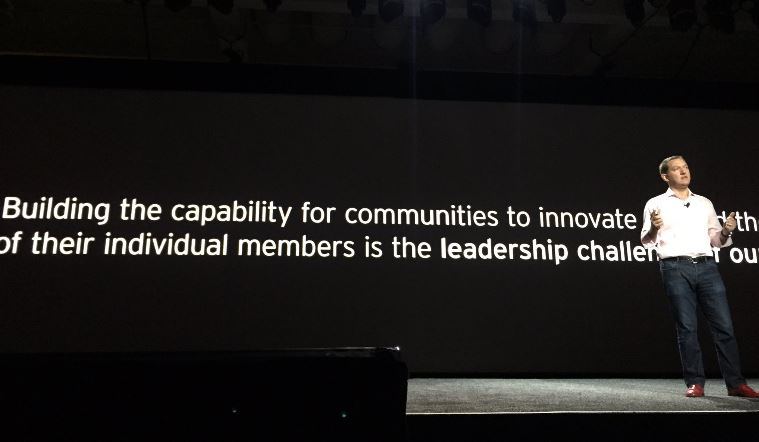
The Red Hat Summit in San Francisco was an opportunity for CEO Jim Whitehurst to talk about the ideology of open source during his keynote presentation, and a message of changing hierarchies underpinned much of what he said.
Whitehurst drew on historical examples of how industrial revolutions created massive change along the lines of hierarchies, processes, and strategies but now those hierarchies that once helped enable great progression are holding back innovation.
"Driving innovation means giving up control," said Whitehurst, followed by "innovation rarely comes from the boardroom or executive suite, it comes much closer to the customer." In essence he is calling for a cultural change in the way that both businesses and vendors approach technology, believing that open source is the way forward.
To some extent this message has already gained traction among many of the largest technology vendors in the IT industry, Microsoft for example has opened up SQL Server to Linux, a move that 10 years ago would have seemed unlikely to say the least.
The belief is that there is more value in doing things the open source way, "For profit driven companies they are realising that there is more value in being open and building ecosystems than locking it up (technology) and staying closed."
Aside from the Microsoft example the industry is full of cases where an essentially proprietary technology driven vendor is opening up their platforms in order to build an ecosystem, just look at SAP where the company is looking to put its S/4 HANA technology at the core and connect to numerous other vendor technologies.
Open source has become about more than an open and collaborative approach to software, it has become a way of life that extends to a belief that almost everything should be open and accessible.
Despite the increasing attention given to open source, Whitehurst clearly appears to feel that more can be done by vendors and businesses to give back to the open source community.
On a couple of occasions the CEO said that the best customers were the ones that were giving back. This is where a cultural shift needs to happen, it’s no longer about just adopting open source technology, it’s about helping to develop it.
This means that businesses should basically be trying to help themselves a bit more, so rather than just relying on the open source community to add new features, or solve problems, head out and develop the extra features and tools that the business needs.
Vendors often talk about a cultural shift being required by businesses when it comes to moving into becoming a data driven business, or a cloud first business, now becoming an open source business is another requirement being placed on them.
To drive home the point of needing to change Elwin Loomis, senior director, store of the future, Target, spoke about the need or innovation, threatening that: "If big companies don’t start acting agile then they will fail."
This isn’t a particularly new message and it is typically backed up by the example of a Blockbuster or Kodak, but this time that message alone seemed to suffice.
The keynote didn’t look at products, although that will surely come on later days, it was all about the ideology of open source and getting more people to buy into it, not just as a passive adopter but as a proactive one that also contributes.
To emphasise the point Mahatma Gandhi’s quote: "Be the change you want to see in the world," appeared on the screens. While this may have added somewhat of a preaching tone, there is clear passion from Red Hat to drive home open source as the future for technology.