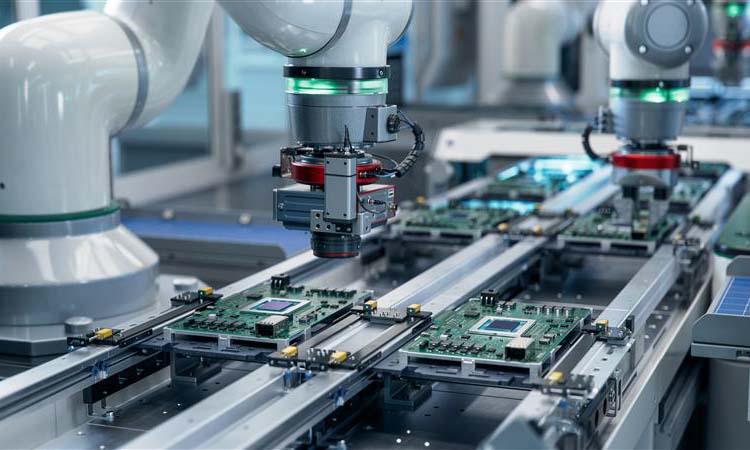

Manufacturers are investing billions in AI, automation, and digital twins – but many are hitting the same invisible ceiling: connectivity.
As factory operations become more autonomous, distributed, and data-intensive, traditional wireless infrastructure is increasingly struggling to keep up. Connectivity is no longer just an operational utility—it has become a strategic enabler of productivity, resilience, and growth.

Private 5G is emerging as the missing link.
Far beyond faster connectivity, private 5G enables real-time data exchange, reliability, and responsiveness required to support Industry 4.0 at scale. It is helping manufacturers reduce downtime, improve quality, increase efficiency, and create more resilient operations — while building the foundation for future AI-driven manufacturing.
Why 5G matters now?
Manufacturing leaders are under growing pressure to do more with less. Rising labour and energy costs, global competition, supply chain volatility, and sustainability targets are forcing manufacturers to rethink how factories operate. At the same time, businesses are expected to increase flexibility, accelerate time-to-market, and meet stringent sustainability targets.
Industry 4.0 technologies—including AI, IIoT, robotics, and digital twins— offer a clear pathway forward. But these technologies only deliver value when supported by reliable, low-latency high performance connectivity.
That dependency in manufacturing is climbing fast. GlobalData projects manufacturing AI spending will rise from $6.37 billion in 2023 to $26.74 billion by 2028, a 33.23% CAGR. The wider AI market is forecasted to approach $1 trillion by 2030.

The reality is simple: AI-driven manufacturing cannot operate effectively on outdated network infrastructure.
Enterprise adoption is accelerating
Private 5G is rapidly moving beyond pilots and proof-of-concepts into full-scale industrial deployment. According to GlobalData, the private wireless market will grow from $4.9 billion in 2025 to $14.6 billion by 2029, reflecting a 28% CAGR and signalling accelerating enterprise adoption. This growth reflects manufacturers prioritising measurable outcomes such as increased uptime, improved product quality, enhanced worker safety, faster operational decision-making, and real-time asset tracking. At the same time, the ecosystem is maturing, with more than 3,600 5G-compatible devices now commercially available and industrial equipment manufacturers embedding connectivity directly into machinery.
Private 5G is no longer an experimental technology. It is becoming core industrial infrastructure.
The business case of private 5G starts with operational outcomes
The most effective way to build a business case for private 5G is through concrete use cases tied to measurable outcomes. Across manufacturing environments, four core metrics consistently demonstrate its value:
- Cycle time (“production throughput”)
- Product quality and defect reduction
- Machine uptime
- Labour productivity and workforce safety
The question manufacturers are now asking is not whether connectivity matters—but how much operational value better connectivity can unlock against the current baseline.
Increasing operational efficiency and reducing cycle time
Reducing cycle times requires seamless coordination across machines, systems, and workers — something constrained by the speed and reliability of the underlying connectivity. In highly automated environments, even small delays in communication can impact throughput and operational efficiency.
Private 5G enables real-time communication across the production environment, allowing systems to respond instantly to changing conditions. Combined with robotics and AI, it helps create more flexible and adaptive production environments, where processes can be optimised continuously rather than in discrete intervals.
Improving quality with real-time intelligence
Quality control is another area where 5G delivers tangible benefits, including enabling advanced applications such as computer vision, which require high data throughput and low latency to function effectively at scale. Traditional wireless networks often struggle to support these workloads, particularly in complex industrial environments.
By enabling real-time image processing and analytics, private 5G allows manufacturers to easily build measures to detect defects earlier and with greater accuracy. This reduces rework, minimises waste, and improves overall product quality. AI-driven quality control systems, which are increasingly deployed in smart factories, rely on this connectivity layer to analyse large volumes of visual data and identify anomalies in real time.
Reducing downtime before it happens
Unplanned downtime remains one of manufacturing’s biggest operational and financial challenges. Even minor disruptions can cause cascading delays across production lines, resulting in lost output, delayed deliveries, and increased labour costs.
Private 5G enables real-time monitoring of assets, machines, and operational systems by connecting sensors where it matters, allowing manufacturers to detect anomalies early and intervene before failures occur. This can translate into substantial savings.
For many manufacturers, downtime reduction becomes one of the fastest and most measurable sources of ROI.
Enabling safer and a more connected workforce
Automation changes the role of the workforce — it does not eliminate it.
Manufacturers still depend on workers being able to interact efficiently and safely with connected systems, machines, and data.
5G enables more efficient use of human resources and AI decision-making, by supporting remote operations, augmented reality (AR)-based training, and real-time collaboration. At the same time, it enhances safety by enabling continuous monitoring of equipment and working conditions.
In hazardous industrial environments, connected sensors and AI systems can proactively detect risks and trigger alerts before incidents occur, improving both operational performance and workforce safety.
Why private 5G instead of traditional wireless?
Unlike public networks or conventional Wi-Fi infrastructure, private 5G networks provide dedicated resources that can be tailored to the needs of the factory environment. This offers several advantages, including cost control, with predictable operating costs and reduced reliance on external providers. It also enables, optimising network performance for specific applications. Enhanced security is another benefit, with private networks providing greater protection of sensitive operational data.
In highly regulated industries or business-critical environments, these factors are particularly important. They allow manufacturers to maintain control over their operations while leveraging advanced connectivity capabilities.
CapEx versus OpEx
Despite the advantages, one of the most common barriers to 5G adoption is the perception of high capital expenditure (CapEx). Deploying a private 5G network requires upfront investment in infrastructure, spectrum, and integration. However, focusing solely on CapEx risks underestimating the broader value of 5G.
The more important question is: What is the cost of inefficiency? Downtime, disconnected systems, quality defects, and suboptimal processes carry ongoing costs that often exceed the initial investment in connectivity. The strongest ROI cases emerge when private 5G enables capabilities that were previously impossible or impractical to scale.
A real-world example: ArcelorMittal France
In a recent use case study, ArcelorMittal France partnered with Ericsson to deploy “5G Steel” across its Dunkirk and Mardyck steelmaking facilities. This deployment enables connected worker applications, real-time material tracking, and a foundation for autonomous vehicles, even within a challenging environment where metal structures and electromagnetic interference typically impede radio propagation. The results included:
- ROI achieved in under two years
- Industrial-grade coverage across challenging industrial complex
- A single network supporting both OT and IT traffic
- Future-proof architecture supporting autonomous vehicles and AR/VR
- 5 times cost advantage compared with a Wi-Fi coverage alternative
- Lower energy consumption than Wi-Fi at scale
More importantly, the deployment established a scalable digital foundation capable of supporting future automation and AI initiatives.
By enabling seamless communication across systems, machines, and people, 5G unlocks the full potential of Industry 4.0 technologies. It allows manufacturers to:
- Scale AI and automation across the factory
- Integrate data from multiple sources into a unified platform
- Enable real-time decision-making and continuous optimisation
This makes it both a direct and indirect driver of returns. Private 5G is no longer about connectivity only — it is enterprise infrastructure for AI, security, and digital operations.
There is no single answer to how long it takes to achieve ROI from 5G, as payback periods vary by use case, deployment scale, and existing infrastructure. However, there are emerging patterns:
- Rapid ROI (months to one year) in targeted use cases, particularly where downtime reduction is the primary driver
- Medium-term ROI (two to five years) for broader transformations involving multiple applications
- Accelerated ROI when 5G enables use cases that were previously unfeasible
- Once integrated, the network platform adds additional future benefits as new technologies evolve
Overcoming possible barriers to 5G adoption
The benefits of private 5G are compelling — but successful deployment requires more than installing new infrastructure. To unlock measurable business value, manufacturers need the right deployment strategy, the right expertise, and the right operational roadmap.
Deployment models: partnered versus self-managed
A critical consideration in any private 5G network is how the network will be managed over time.
Some manufacturers choose a self-managed approach, building in-house capabilities to operate and maintain the network. This can provide greater control, but it also requires expertise in cellular networking, security, and operational management.
Others opt for partnered or managed service models, leveraging external providers to handle deployment and operations. This can reduce complexity, accelerate implementation, and help organizations realise value faster.
For many manufacturers, the most effective approach is a hybrid model—combining internal operational oversight with external expertise and support.
The right model ultimately depends on business priorities, internal resources, and long-term transformation goals. What matters most is ensuring the network can evolve alongside the business and support future operational demands.
Integrating legacy systems
Many manufacturing plants still rely on legacy systems that were never designed for modern connectivity.
Integrating these systems with 5G networks requires planning and resourcing, so begin by identifying potential integration zones.
Closing the skills gaps
Deploying and managing private 5G requires specialised skills that many organizations are still developing internally.
Rather than delaying transformation initiatives, many manufacturers are choosing to partner first and build internal capability over time. This approach accelerates deployment while reducing operational risk and easing the transition toward more connected operations.
Securing the connected factory
As manufacturers scale connected devices, machines, and sensors across the factory floor, cybersecurity becomes even more critical.
Private 5G can provide enhanced security and operational control compared with traditional wireless environments, but security must still be built into the network architecture from day one. Protecting operational technology (OT) environments and business-critical data requires a proactive, end-to-end security strategy.
Measuring business impact
One of the biggest obstacles to demonstrating ROI is the lack of clearly defined operational baselines.
In order to understand the ROI, define KPIs and baseline early in the implementation. Many organisations lack clear baseline metrics, making it difficult to attribute improvements directly to the technology. Establishing a strong measurement framework is, therefore, a critical first step in building a credible business case.
What to look for in a private 5G partner
Technology alone will not deliver transformation outcomes.
Choosing the right partner is critical to simplifying deployment, reducing complexity, and accelerating time-to-value.
Manufacturers should look for partners that offer:
- Industrial-grade reliability (OT vs IT)
- End-to-end lifecycle support
- Flexible deployment models, including managed and self-managed options
- Proven expertise across manufacturing and industrial operations
- Strong cybersecurity and integration capabilities
Unlike repurposed enterprise IT solutions, private 5G networks are specifically engineered to meet the demands of industrial environments to support business-critical operations—delivering the low latency, reliability, and security for applications such as:
- Real-time analytics
- Autonomous systems
- Computer vision
- Connected worker solutions
- AI-driven automation
One of the greatest advantages of private 5G is its ability to turn connectivity into actionable operational insight. By enabling reliable, real-time data transmission across the factory floor, manufacturers can move beyond isolated pilot projects and begin scaling AI, automation, and analytics across the enterprise.
A private 5G portfolios typically combine radio technology, core networks, software, and optional managed services—enabling manufacturers the flexibility to choose between pre-packaged solutions or fully customised deployments based on their operational requirements.
Equally important is selecting a partner that can support the entire transformation journey: from network design and deployment to integration, optimisation, and long-term operational support.
The opportunity is no longer theoretical. Manufacturers are already moving from pilot projects to enterprise-scale deployment — and the gap between early adopters and competitors is beginning to widen.
The question is no longer whether connectivity matters.
It’s how quickly manufacturers can turn connectivity into measurable competitive advantage.
Explore how private 5G can accelerate manufacturing transformation
Access real-world manufacturing deployment examples, industry insights, and practical ROI frameworks to understand where private 5G can deliver the greatest operational impact.
Discover how manufacturers are building more connected, resilient, and AI-ready operations with private 5G.